Concrete is one of those jobs where the mistakes don't show up on day one. A bad pour looks fine for a season, sometimes two, and then you've got a driveway cracking into slabs you can rock with your foot, or a pool deck that's pulling away from the coping. By the time you can see the problem, the money's spent. So the choosing part matters more than it does for a lot of other trades.
Ask about the mix, not just the price
Get three quotes and they'll usually be close on labor, but the concrete itself can vary a lot and that's where corners get cut. A standard residential driveway or slab should run 3,000 to 4,000 PSI. Anything quoted lower than that for a driveway is a red flag, not a bargain. Ask what thickness they're pouring at, too. Four inches is typical for a driveway or patio, six for something that'll see a truck or an RV parked on it regularly. If a contractor can't tell you the PSI and the thickness without checking a chart, that tells you something.
Ask whether they're using wire mesh or rebar. Mesh is cheaper and fine for a lot of flatwork, but it has to actually sit in the middle of the slab, not get dragged to the bottom during the pour, which is the most common way mesh reinforcement fails to do anything. Rebar on chairs, spaced properly, holds its position and does more for a driveway or a slab that'll carry real weight.
What Daytona Beach's ground does to a slab
The soil around here is mostly sand, which drains fast and that's actually a point in your favor for concrete work. The problem is what's underneath it and how close it sits to water. A lot of lots east of the Halifax River and near the barrier island have a high water table, and some low-lying pockets around older parts of town carry muck or organic fill from what used to be wetland. A contractor who knows the area will test the base compaction before they ever set forms, and on soft or organic spots they'll bring in extra fill and compact it in lifts rather than dumping it all at once and hoping.
Skip that step and the slab settles unevenly a year or two later. You'll see it as a driveway that dips near the garage apron, or a patio slab that tilts water back toward the house instead of away from it. Grading matters just as much as the mix. A patio or slab should pitch about a quarter inch per foot away from the foundation. On a flat sandy lot that's easy to get wrong if nobody's checking with a level as they screed.
Heat, humidity, and hurricane season change the schedule
Concrete doesn't cure on a fixed clock, it cures on a chemical reaction, and Florida heat speeds that reaction up in a way that can work against you. In July and August, with slab temperatures well above what the mix design assumes, concrete can set faster than the crew can finish it, leading to a rough or cracked surface if they're not adjusting the mix or timing the pour for early morning. A contractor working here should be pouring at dawn in summer, not at noon, and should be wet-curing or using a curing compound to slow moisture loss in that heat rather than letting the surface dry out in an hour.
Then there's the rain. Afternoon thunderstorms from June through September are routine, and hurricane season runs June 1 through November. A pour that gets rained on before it sets can end up with a scaled, pitted surface, and a slab poured the week a named storm is sitting in the Atlantic is a scheduling risk any local contractor should be watching for. Ask how they handle a forecast that turns on them mid-project. If they shrug, that's not confidence, that's inexperience.
Permits, inspections, and what's already in the ground
Depending on where your property sits, permitting runs through the City of Daytona Beach or through Volusia County if you're in an unincorporated area. For a driveway, patio, or slab, that typically means a permit application, a rebar or reinforcement inspection before the pour, and a final inspection after. A licensed contractor pulls this themselves and knows it. If someone offers to skip the permit to save you money, understand that you're the one who owns that risk when you go to sell the house, not them.
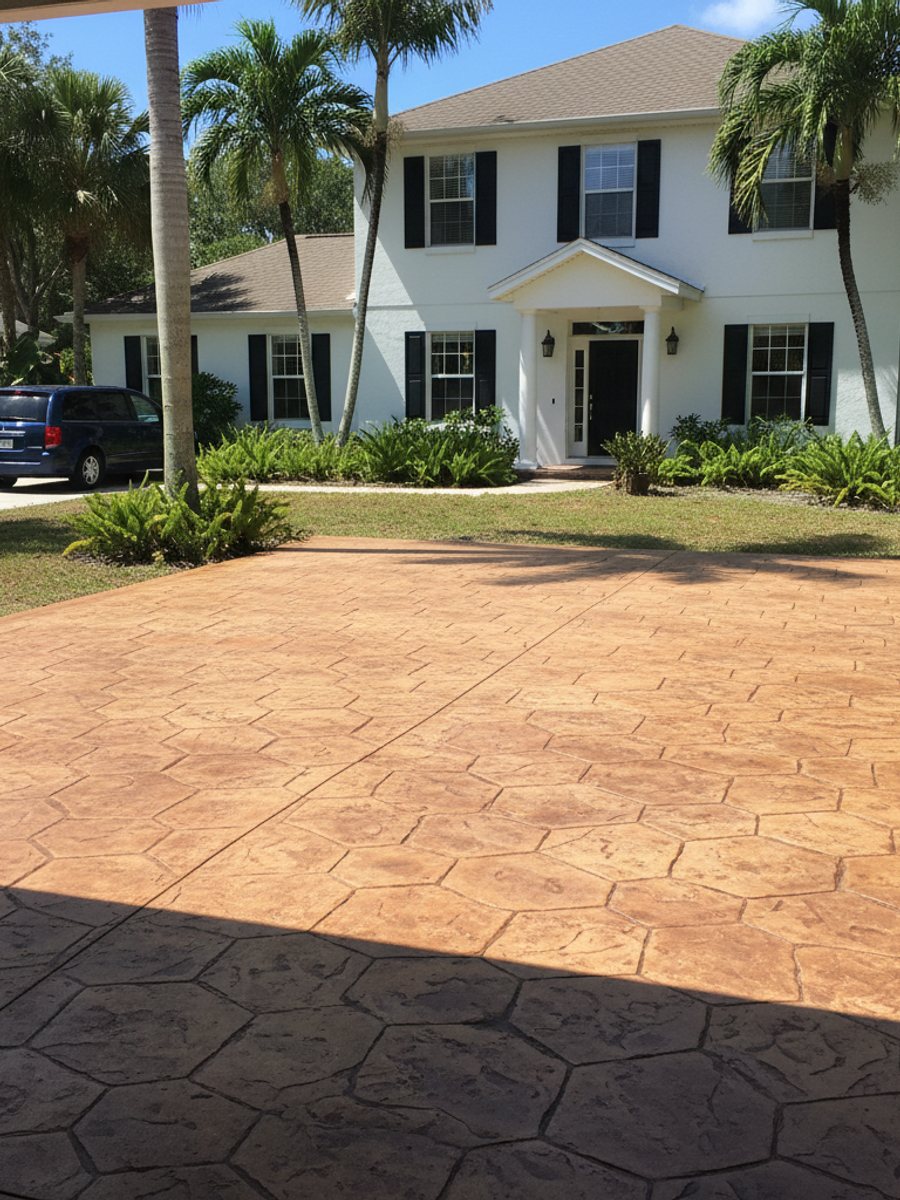
Older neighborhoods, Holly Hill, South Daytona, parts of the mainland built in the 1950s and 60s, often have driveways poured with no control joints at all, or joints cut too far apart, which is why you see those long diagonal cracks running the length of the slab. A joint should generally be cut roughly every 8 to 10 feet for a standard 4-inch driveway, done within the first 24 hours after the pour, before the concrete decides where it wants to crack on its own. Newer subdivisions like LPGA International or Pelican Bay tend to have HOA design standards on top of the county permit, which can dictate finish or color for anything visible from the street, including stamped concrete or decorative curbing. Ask up front if your HOA has rules, because redoing a finish after the fact costs more than getting it approved before you pour.
What to walk away from
- No Florida contractor's license number they can give you on the spot, or one that doesn't match the name on the quote.
- No workers' comp or liability insurance. If a worker gets hurt on your property and there's no coverage, that liability can land on you.
- A quote with no PSI, no thickness, and no mention of reinforcement, just a square footage price.
- Pressure to pay the full amount up front. A deposit is normal, the balance should come after the work passes inspection.
- Vague answers about how long before you can drive on it. The honest answer is about 7 days for light foot and car traffic and closer to 28 days for full strength, and a contractor who knows the trade will tell you that without hesitating.
None of this is complicated once you know what to ask. A contractor who's actually poured concrete around here for a while should be able to answer every question above without reaching for a script. That's really the test. If you're getting quotes for a driveway, a pool deck, or a slab and want to compare against how we'd handle the soil, the schedule, and the permit on your specific lot, you can see the range of work we do at Apex Concrete Solutions.